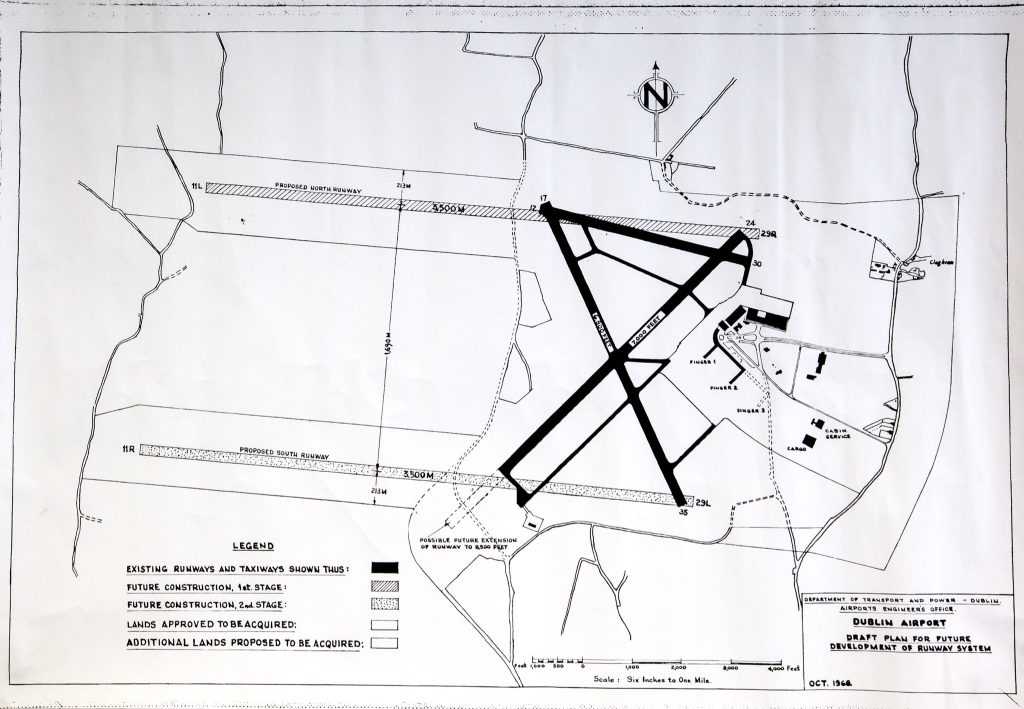
Planning, design, development and construction for the north runway has been going on since the 1960s. Yes, 60 years. When you plan and get permission for a runway only a portion of the exercise is the actual concrete structure on the airfield. The rest of it is about where the aircraft will go when they leave the ground on departure and approach the ground on arrival. In this way it’s not like when you build a building, it’s more like a motorway in the sky. You’ll notice that in the picture the runways are designated 11-29 rather than 10-28 because the earth’s magnetic field has changed so much since this was drawn!
Planning Conditions
The planning permission granted to DAA, which they accepted when they built the runway, included several conditions. Why, you might ask? Like in all things construction, there is a balance to be struck between the benefits to the owner/operator, the society and the economy on the one hand the the damage done to people who live near the airport or under the departure and approach tracks.
The range of that damage runs from annoyance to mental health problems. The noise from the aircraft differs depending on where on the track you live. No matter where you live the noise is not constant, it ranges from near silence to loud (at Kilcoskan National School, a median of 80.6 dBA for the loudest type) over the course of 45 seconds and then back to silence, just in time to start all over again as planes take off every 90-120 seconds for hours on end. This is not a constant drone in the background that you can “just tune out”!
One of the major conditions that was applied relates to the number of night flights. This was put at 65/night (defined as 23:00 to 07:00) on average, measured over a 92 day period in summer. In effect, this allowed about 6,000 night movements over that period. In 2023 the airport used up this allotment in about 55 days: 10,069 night movements in the 92 days, an average of 109 a night against the 65 allowed. Our proposal is not directly relevant to this part of the problem. However, by redirecting the departing aircraft onto a route that overflies solar farms and mostly empty fields instead of the homes of about 14,000 people we, hope to alleviate the damage and perhaps make the early flights less unpalatable.
In an RTE Prime Time programme covering the issue, Kenny Jacobs, DAA CEO, claimed that the planning permission is unclear. We’ve addressed some of that in a separate article.
Compensation of Local Residents
Most people agree and understand that the airport is a national asset and part of the strategic development of the country’s economy; progress must not be stopped. Far from being an argument for belittling and ignoring the people negatively affected by it, this demonstrates that the airport is developing enough financial benefit for the society that we can afford to take care of those we are allowing to be hurt. In particular we need to take care of those few people whose home we have destroyed by flying over them at low altitude. In fact the DAA agreed to this and purchased several houses and paid to sound insulate others. However, they then changed the flight-path so different houses are now affected by the noise.
To be clear compensation is NOT the objective for the vast majority of people affected and not necessary for most.
The best first step, is to minimize the number who need to be compensated. Let’s make those “few people” as few as possible. That’s the root of our proposal to modify the departure tracks to ensure the fewest number of people are unexpectedly overflown.