For almost four years, Fingal County Council said complaints about Dublin Airport’s north runway routes were too complex to decide. Then it decided in a fortnight. Its answer reads almost word for word like a letter daa sent it in 2022.
Now An Coimisiún Pleanála (ACP) has been asked to look again.
The warning letter
In September 2022, weeks after the north runway opened, Fingal sent daa a formal warning letter under section 152 of the Planning and Development Act. One of the things it warned about, in Fingal’s own words:
“Aircraft flight paths are not operating in accordance with the permitted flight paths”
The “permitted flight paths”. Fingal’s phrase, not ours.
A council cannot send a warning letter on a whim. The law allows it only where the complaint is not “vexatious, frivolous or without substance or foundation”. Fingal looked at the complaints, decided they had substance, and acted.
daa wrote back on 19 October 2022. Its answer: the permission “did not grant, or purport to grant, planning permission for flight paths”.
“Matters of some complexity”
Then nothing happened, for years.
In March 2026 the Ombudsman reported that Fingal “will endeavour to ensure that a decision on enforcement is made within the next 6 months”. Those six months ran to 19 September.
In May 2026 Fingal told complainants the investigation involved “matters of some complexity” and that it “has not yet made a decision on enforcement”.
On 8 September 2026 it told us it had “not made any determination at present”, and that “it is not possible to estimate any specific time for completion”.
Then, a fortnight
- 18 September: a planner’s report.
- 22 September: a decision not to enforce.
- 24 September: the file closed.
Fingal’s conclusion: “flight paths are not development for the purposes of the Planning and Development Act 2000 (as amended) and so are not capable of being governed by a planning permission. As a result, no unauthorised development can have occurred”.
Almost four years too complex to decide. Ten days from “not possible to estimate” to a finished report.
Spot the difference
Fingal’s 2022 warning letter spoke of “the permitted flight paths”. daa answered:
“The NR PP did not grant, or purport to grant, planning permission for flight paths and so the reference to “permitted” flight paths is inaccurate.”
Four years later, Fingal’s planner:
“the application documentation referred to in that condition did not purport to seek permission for any specific flight paths. Furthermore, no specific condition is imposed in the North Runway Permission purporting to regulate flight paths.”
“Purport” turns up four times in the report.
daa again, on who is in charge:
“Flight paths or airspace approvals are subject to separate statutory regulatory processes which are within the ambit of a section of the Irish Aviation Authority”
Fingal:
“Such matters as flight paths are instead regulated by other statutory/regulatory regimes and bodies including the Irish Aviation Authority and AirNav Ireland.”
And on what the 2004 Environmental Impact Statement assessed. daa, 2022:
“the EIS and EIS Addendum did not provide particulars of specific flightpaths, but did assume certain indicative flight paths, in order to model, as best it could on the basis of available information at the time, the likely noise effects of the proposed development”
Fingal, 2026:
“The EIS (including the Addendum) did not provide details of specific flightpaths, but did assume indicative flight paths, in order to model the likely noise effects of the development.”
The report quotes the same two passages of the 2004 Environmental Impact Statement as daa’s letter, in the same order. It cites no court judgment for its conclusion that the routes are “not development”.
Under section 10 of the Freedom of Information Act we asked Fingal for its reasons, and the findings of fact behind its decision. On 10 November it refused, saying “the records sought do not exist”. The only reasoning on file is the planner’s report.
daa made the argument in 2022. Fingal called it too complex for four years, then decided in a fortnight by copy-pasting daa’s homework.
Same answer, wrong question
We had already asked Fingal a different question. On 14 September, under section 5 of the Act, we asked whether flying the north runway’s departures along today’s routes has changed how the airport is used.
On 9 October Fingal gave the same answer: “aircraft flight paths do not fall within the statutory definitions of development”. It did not say whether the use of the airport has changed.
The routes were part of how this airport was permitted to be used. Change the routes and you change the use.
Nine conditions for nothing?
Fingal’s answer has a consequence it does not spell out: Fingal has to be saying that An Bord Pleanála didn’t understand its own permission.
In 2007 the Board set nine conditions on the route that was assessed: which runways to use and when, which decides how many people are overflown; who got insulation, and where the noise is measured. On Fingal’s reading, that route was never part of the permission, so all nine were dead on arrival. Schools insulated under a route no plane flies. Noise monitored where nobody is overflown.
That is Fingal’s position, not ours: that the Board wrote nine pointless conditions.
And Fingal itself? Granting permission for the runway in 2006, it made it a condition that “Flight paths, aircraft approaches, and preferential use of runways in different weather conditions shall be as detailed in the EIS Addendum on file”.
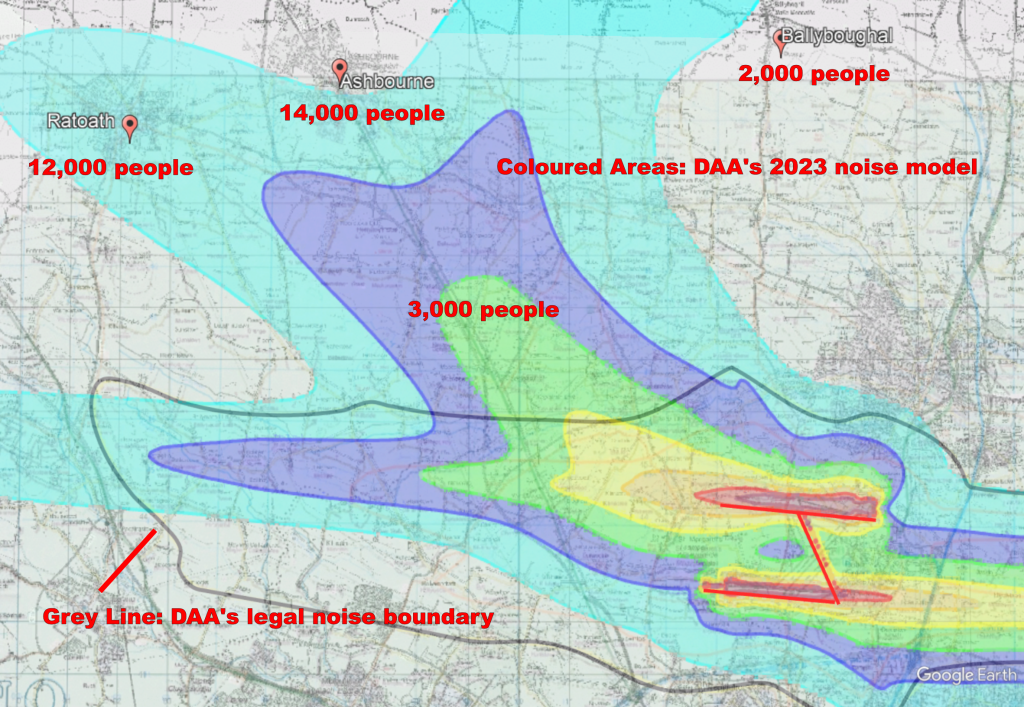
The routes flown since 2023 put almost 14,000 people newly under direct overflight. Kilcoskan National School sits 85 metres from today’s route, and about 2.5 km from the one that was assessed. On a full westerly day, daa’s own monitor at the school counts about 300 departures overhead.
If Fingal is right, nobody ever has to assess that, and nobody can be made to.
Over to ACP
On 4 November we referred Fingal’s declaration to An Coimisiún Pleanála. We have asked it to decide the question Fingal did not answer, to say whether an environmental assessment is needed, and to hold an oral hearing.
ACP’s decision binds Fingal and daa. Only the High Court can overturn it.
ACP has acknowledged the referral. It has not yet issued a case reference; we will add it here when it does.