Category: News

  • NRTG takes Ireland to Europe over Dublin Airport

    North Runway Technical Group files formal complaints with European Commission, European Parliament, and Aarhus Convention

    DUBLIN, 2 March 2026. The North Runway Technical Group (NRTG), a voluntary group with aviation and engineering expertise, including current and former airline pilots, has today filed three simultaneous complaints with European institutions over Ireland’s treatment of environmental law at Dublin Airport.

    The complaints, filed with the European Commission, the European Parliament Petitions Committee, and the Aarhus Convention Compliance Committee, allege that Ireland is in breach of six EU instruments covering environmental impact assessment, noise regulation, airport noise competent authority independence, aerodrome safety, air navigation procedures, and public participation rights. The complaints document a pattern in which every regulatory body that has attempted to enforce any environmental constraint on Dublin Airport has been met with either High Court litigation by the airport operator or legislation by the Government to remove the constraint.

    The EU filings follow a detailed submission to the Oireachtas Committee on Transport, filed last week as part of the Committee’s pre-legislative scrutiny of the Dublin Airport (Passenger Capacity) Bill 2026. NRTG has requested a public hearing before the Committee.

    The Bill: not raising the cap, removing it forever

    NRTG’s submission to the Committee highlights that the Bill does not merely remove the current 32 million passenger cap. It prohibits any future government from ever imposing a passenger capacity condition on Dublin Airport. It exempts itself from Ireland’s Climate Action Act. It gives the Minister power to revoke planning conditions by order, with consultation that is discretionary rather than mandatory. It compresses the timeframe for legal challenges and removes the right of appeal to the Court of Appeal.

    “Once it is illegal to cap passengers, any environmental condition that has the effect of limiting throughput becomes a target. Noise limits, wastewater restrictions, flight curfews: DAA can argue that each one is a passenger cap by another name, and this Bill gives them the legal basis to have it removed,” said Gareth O’Brien of NRTG.

    Infrastructure not ready

    The infrastructure required to support growth beyond 32 million passengers does not have planning permission. DAA’s application for 11 major projects was returned by Fingal County Council in December 2024 with 375 material deficiencies and remains incomplete.

    The enforcement record

    Fingal County Council identified nine categories of planning non-compliance at Dublin Airport in September 2022. It has issued enforcement notices on two: night flights and the passenger cap. Both enforcement actions were neutralised. DAA obtained a High Court stay against the night flight notice. The Government introduced this Bill in response to the passenger cap enforcement. The remaining seven categories, including flight paths affecting 30,000 residents, remain unenforced after more than three and a half years. The Ombudsman has found Fingal’s responses to its investigation “unsatisfactory.”

    “We support sustainable growth at Dublin Airport, but growth must follow compliance,” said O’Brien. “If a planning condition is breached, the answer is enforcement, not legislation to remove the condition.”

    The Advocate General and the Government’s response

    On 12 February 2026, the Advocate General of the Court of Justice of the European Union issued an opinion in Case C-857/24 supporting the IAA’s inclusion of the passenger cap in slot coordination, finding that historic airport slots “are not property rights.” Despite the EU’s own legal officer vindicating the regulatory approach, the Government continues to legislate to remove the cap.

    Utilities: housing versus the airport

    Dublin Airport’s wastewater is treated at the Ringsend plant, which is persistently overloaded and in breach of the EU Urban Wastewater Treatment Directive. Uisce Eireann has warned that housing connections across Dublin will be frozen by 2028 without new drainage infrastructure. Developments have already been delayed for lack of wastewater capacity. A EUR 500 million upgrade to Ringsend is not complete until 2027.

    “The Government is giving one facility unlimited access to water and sewage infrastructure while new housing needs connections to the same system. If the airport cannot be capped, will housing be?” said O’Brien.

    “We have exhausted every domestic avenue,” O’Brien said. “We are now asking Europe to hold Ireland to its own laws.”
  • Release: Corporate Governance Campaign

    The North Runway Technical Group (NRTG) has launched a major public letter campaign targeting government departments, regulators, and public bodies over the State’s ongoing failure to enforce planning and environmental law at Dublin Airport.

    A series of 14 formal letters—now available on the NRTG website—have been sent to the Minister for Transport, the Minister for Local Government and Planning, Fingal County Council, the Corporate Enforcement Authority, airlines, and other key stakeholders.
    The letters warn that continued State inaction exposes communities, the environment, and the taxpayer to escalating legal, financial, and safety risks.

    “This campaign is not about raising new concerns,” said Gareth O’Brien of the North Runway Technical Group. “The facts have been known for over two years. What is missing is action. Every day the Government refuses to intervene increases the risk of litigation, regulatory breaches, and public harm.”

    State Failure at the Heart of the Crisis

    The letter campaign highlights that multiple State bodies—including Fingal County Council, the Department of Transport, and the Aircraft Noise Competent Authority (ANCA)—have failed to act despite clear evidence that the Dublin Airport Authority (daa) is operating the North Runway in breach of its 2007 planning permission.

    Key facts include:

    • An Bord Pleanála (ABP) has confirmed that the current North Runway departure routes are materially different from those approved and assessed in the 2007 Environmental Impact Statement (EIS).
    • The Irish Aviation Authority (IAA) has confirmed that the unauthorised early turns (at only 400 feet above ground) were not mandated for aviation safety purposes.
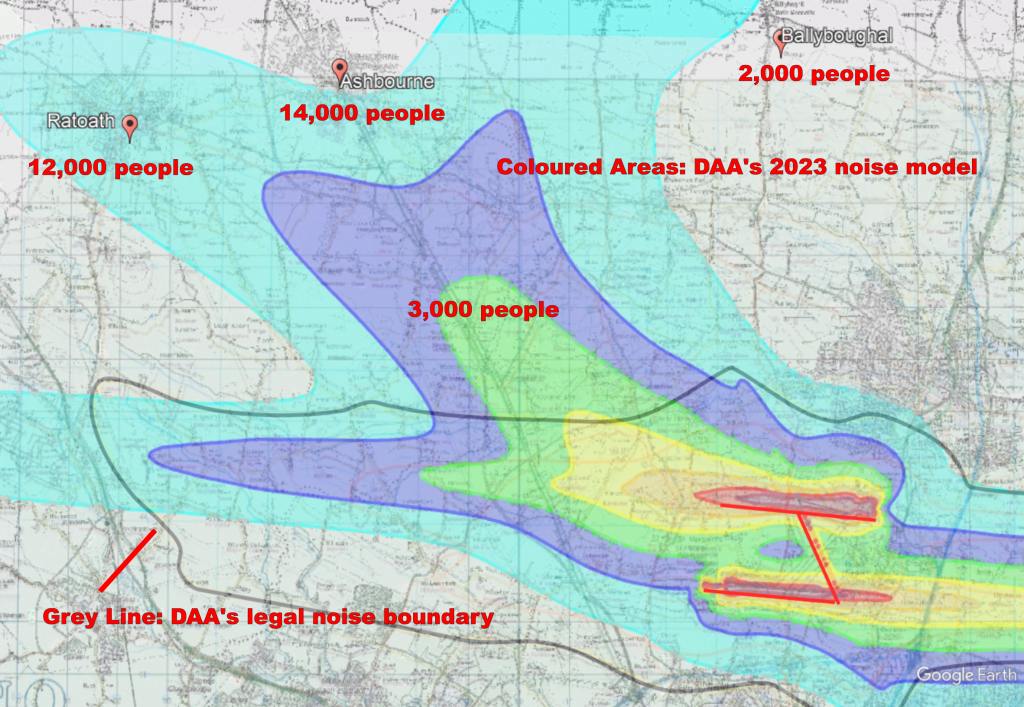
    • These unauthorized changes have caused a 335% increase in the number of people directly overflown, exposing thousands of residents to noise levels never assessed or approved.

    Despite these confirmations, Fingal County Council has failed to respond to direct requests for confirmation of enforcement action, and Ministers responsible for transport and planning have failed to intervene.

    Public Safety and Environmental Risks

    The early departure turns now send aircraft over a newly constructed bird sanctuary created under the original planning conditions—a routing that introduces new bird-strike safety risks that were never assessed in the original planning process. This further undermines daa’s claims to have introduced the new routing for “safety reasons”.

    Additionally, serious governance concerns have been raised about the daa’s leadership, including a declared conflict of interest involving its CEO, who holds shares in airlines operating from Dublin Airport.

    Risks Facing the State

    • Legal Action: Legal challenges by residents and environmental groups over the unauthorised operations.
    • EU Infringement: Failure to enforce planning conditions may expose Ireland to EU infringement proceedings.
    • Public Trust: Every day of inaction erodes trust in Ireland’s planning system and regulatory institutions.

    About the Letter Campaign

    The NRTG has issued 14 detailed letters outlining the failures across State and regulatory bodies, setting out the technical breaches, legal implications, and urgent steps required.
    The full set of letters is available for public review:

    Click Here to see the letters

  • Ireland’s War on Disinformation Must Start With Its Own State Agencies

    Last week, the Irish Government launched its national strategy to counter disinformation — a vital and overdue initiative in an era where public trust is under strain. The strategy pledges to fight false narratives, promote transparency, and build confidence in state institutions.

    But while Ministers decry “fake news,” one of their own state-controlled companies — the Dublin Airport Authority (daa) — is running what many believe to be a government-backed campaign of institutional disinformation.

    And it’s operating outside the public’s right to know.

    170,000 Complaints. One Scripted Response. No Accountability.

    Over the past two years, residents across Meath, North Dublin, and surrounding areas have submitted more than 170,000 noise complaints due to altered flight paths from Dublin Airport’s North Runway. These complaints almost universally receive identical, templated responses from daa.

    The language is always the same:
    – “The aircraft remained within the Noise Preferential Route (NPR).”
    – “There was no infringement of track procedures.”
    – “Routing is the responsibility of AirNav Ireland.”
    – And, when non-compliance is acknowledged: “The aircraft was vectored for safety reasons.”

    But the fundamental premise is flawed. The only lawful Noise Preferential Route is the one detailed in daa’s 2007 Environmental Impact Statement (EIS) — the document that formed the basis of their planning permission.

    That legally binding route prohibited early turns over communities like Ratoath and East Meath, stipulating no turn before 5 nautical miles west of the runway. What’s being flown today is not that route. It is a self-designed deviation never subject to environmental assessment, never approved by An Bord Pleanála, and never disclosed transparently to the public.

    daa is referencing a fictional NPR — and dismissing thousands of legitimate complaints with circular reasoning and generic disclaimers about “safety reasons.”

    And Now Add This: daa Is Immune to Freedom of Information

    Unlike most public bodies, daa is exempt from the Freedom of Information Act. This means:
    – Citizens cannot request internal emails or decision records.
    – There’s no transparency on who writes the templated responses.
    – The public cannot examine how “safety reasons” are determined — or if they’re being used to cover for operational convenience.

    This is a state-owned company, funded and overseen by government, operating critical national infrastructure — yet shielded from public scrutiny.

    “Safety Reasons” as a Blanket Justification

    In the few cases where daa does acknowledge a deviation from the NPR, it attributes the change to “safety reasons” — without further explanation or independent corroboration.

    This tactic raises deep concerns:
    – There’s no transparency about what safety protocols were invoked.
    – No public accountability for systemic patterns of deviation.
    – And no evidence that these safety justifications couldn’t be avoided by simply reverting to the legally approved route — which was, in fact safer by design.

    In short, “safety” has become a catch-all excuse, not a reasoned response grounded in law or planning compliance.

    This Directly Contradicts the Government’s Strategy

    Minister Patrick O’Donovan rightly said:
    “Disinformation is a danger to democracy.”

    Yet here we have a state agency:
    – Making misleading public statements about compliance.
    – Deflecting lawful objections by invoking “safety” without transparency.
    – Refusing to acknowledge it abandoned its legally approved route.
    – All while exempt from FOI — and completely unaccountable to those it affects most.

    What Needs to Happen

    If the Government truly wants to fight disinformation, it must start by cleaning its own house. That means:
    1. Including daa and others in the remit of the Counter Disinformation Oversight Group.
    2. Mandating transparency and auditability for public-facing claims.
    3. Reinstating public oversight of daa through FOI.
    4. Reviewing all noise complaint responses for factual accuracy and legal compliance.
    5. Requiring daa to revert to the flight paths approved in the 2007 planning permission.

    Conclusion: Disinformation Starts — or Ends — With the State

    This is more than a local noise issue. It’s a democratic integrity issue. The Government cannot credibly fight disinformation while allowing its own agencies to mislead the public, deflect scrutiny, and invoke “safety” as a shield for non-compliance.

    If the State is serious about restoring trust, it must begin not with those easiest to regulate, but with those hardest to hold accountable.

    Now forget this is daa and the flight paths. How many other State bodies behave in a similar way when anyone dreams of expecting them simply to fulfill their mission: HSE, Aircorp (Chemical Brothers), HSE, Tusla, Department of Health, Gardai  (Sergeant Maurice McCabe), Revenue Commissioner (Ansbacher), OPW … and of course the HSE.

    We must ensure that striving for transparency and truth is applied to the organs of the State, rather than used by them as a weapon against criticism and accountability.

    Anything less is not a disinformation strategy — it’s a communications strategy.

  • Fingal Councillor Criticises DAA’s Approach to Planning Compliance

    https://dublinpeople.com/news/northsidewest/articles/2025/03/19/dublin-airport-fcc-row-march25/

    Independent councillor Jimmy Guerin went one step further, dubbing the behaviour of the daa as “Trumpian.”

    “The daa has publicly pointed the finger at Fingal County Council as the cause of the problem;  this is far from acceptable behaviour.”

    “The daa is not responsible for planning policy, and it is not above planning regulations or the law,” he said.

    “The daa’s Trumpesque approach of making false claims, misrepresenting facts, and incessantly seeking the limelight is harming Ireland’s aviation and tourism sector.”

    “Many have been misled into believing that Fingal County Council’s planners are to blame, when in reality, it is the daa’s own failures that have contributed to this mess.”

    He criticised what he called “alarmist carry-on,” and he said it was “disrespectful to the planners in Fingal County Council who are exceptional in their work.”

    “It often appears that daa’s senior management is keeping its PR department busier than its planning department,” he remarked.

    Councillor Guerin said that either the board of the daa or the Minister for Transport should intervene and replace the current senior management team with one that is “solution-focused, collaborative and capable of restoring the positive and productive working relationship that previously existed between the daa and Fingal County Council.”

  • RELEASE: IAA Debunks DAA’s Safety Claims

    IAA debunks DAA’s “Safety Reasons” claim

    Ashbourne: 10/March/2025

    The Irish Aviation Authority, (IAA) has released their submission in response to An Bord Pleanála’s (ABP) September 2024 draft decision on Dublin Airport’s night flights planning application (the so-called Relevant Action).

    This came in the same week that ANCA, the Aircraft Noise Competent Authority released a letter requiring daa once again to submit a noise study, this time for its so-called “no-build” application to increase the capacity of the airport from 32 to 36 million annual passengers.

    Background

    Dublin Airport (daa) is struggling with major planning issues and it’s mainly due to incorrect flight paths from its North Runway.

    The Key Issue: Flight Paths and Passenger Limits

    Daa wants to increase its passenger limit from 32 to 36 or 40 million, but there’s a problem: according to An Bord Pleanála, flights from the North Runway are not following the approved routes.

    Originally, aircraft were supposed to fly straight for 9 km over empty fields before turning. Instead, pilots are making sharp turns at the end of the runway and just 400 feet above the ground. This affects 30,000 people with unexpected noise, violating Irish and EU laws.

    Now the IAA has responded to daa’s claims that IAA forced these changes:

    Daa claims the Irish Aviation Authority (IAA) told them to change the flight paths for “safety reasons.” However, the IAA has now stated that they never required these changes.

    In fact, the IAA criticizes An Bord Pleanála (ABP) for accepting daa’s claims without proper investigation. The IAA’s response makes it clear: safety was never the reason for the changes.

    NRTG spokesperson Gareth O’Brien said,

     “The IAA’s response makes clear how An Bord Pleanála and others have been misled by daa’s often repeated claim that IAA required the flight paths to turn for “safety reasons”. Perhaps daa should now explain the real reason they chose to ignore the Noise Preferential Route granted in their planning permission and use a short cut that dumps noise on 30,000 people?”

    What Happens Now?

    Daa is refusing to submit the required noise study to ANCA while ABP considers their night flight application, because it would reveal their flawed flight path problem. Without this study, their planning applications to increase the cap are blocked.

    Daa hopes ABP will confirm their draft decision with acceptance of their non-compliant flight paths for “safety and operational reasons”. However, with IAA directly calling out ABP’s gross errors and misunderstanding as well as debunking daa’s safety claim, it is extremely unlikely that ABP’s decision would survive the inevitable judicial review.

    Conclusion

    Dublin Airport’s growth is at risk, endangering Ireland’s national economy because daa has ignored planning conditions and environmental law to create a short cut flight path.

    Daa’s next step towards increasing the cap is obvious: fix the flight paths to follow the approved Noise Preferential Route. So why will they not do it?

    ENDS

    For more detailed information CLICK HERE.

  • Spring 2025 Update

    Summary of the north runway fiasco as a new Transport Minister takes office

    This is not a matter of Planning Permission (“we must wait for ABP”) or planning enforcement (“that’s up to Fingal Local Authority”). This is a matter of corporate governance and responsibility. The failure of Minister Jack Chambers and the officials in the Department of Transport, particularly Ethna Brogan (The Director General of Civil Aviation in Ireland) to provide any oversight to daa has allowed a culture of impunity to go unchecked and a campaign of Deny, Defer, Deflect to go unchallenged.

    NRTG is not requesting the Minister to interfere in planning permission, although the Chair of daa wrote a letter to the Taoiseach asking for just that. NRTG is asking the Minister as the proxy owner of daa to show leadership and apply independent oversight and corporate governance to what has become a rogue entity.

    ·         2007 daa requests and receives planning permission to build and operate the north runway

    o   Daa requests 5 nautical miles straight ahead and minimum 3,000ft altitude before any turns as the only departure route (just like the south runway). This is the route for the entire Environmental Impact Statement (EIS) and is referred to in industry as the Noise Preferential Route.

    o   Fingal rejects. ABP Inspector recommends rejection. ABP overrules and grants, with 34 conditions citing EIS. Still the ONLY permission in place

    o   Condition 1 – Do not deviate from the EIS

    ·         2016 daa realizes they want to operate different flight paths for CAPACITY reasons resulting in the first Relevant Action.

    o   Daa blames “safety requirements” for the change, citing requirements in ICAO 9643 published in 2004, so available during the original process.

    o   Public consultation carried out in Fingal only, despite over 90% of the departure disturbance occurs in Meath.

    o   ANCA formed and requires proper noise analysis as part of RA.

    o   Daa withdraws the application

    ·         Aug 2022 Runway opens with a Standard Instrument Departure (SID) using routes fundamentally different from both 2007 planning and 2016 RA public consultation.

    o   Fingal threatens enforcement

    o   Daa tells Oireachtas they were “greatly surprised by the route the aircraft took” and the SIDs are nothing to do with daa, being “handled by the regulatory authorities”.

    o   IAA CEO informed the same Oireachtas committee that “everyone in the world of aviation knew the flight paths 2 months before the runway opened”

    o   DAA is legally the Aerodrome Operator and 100% responsible for the aerodrome and literally the only entity that can request approval from IAA to change the SIDs. No one else is responsible for the SIDs.

    o   Daa rapidly changes the SID (Feb 2023) to move the bulk of the departure noise from Fingal to Meath

    o   Since then, Fingal has refused to answer any questions regarding enforcement of Condition 1 and no such enforcement undertaken against daa, its largest ratepayer.

    ·         July 2023 RTE Prime Time covers the flight path problem including interview with daa CEO Kenny Jacobs (KJ)

    o   Documentary evidence shows KJ repeatedly gave incorrect answers to questions about the north runway

    o   Ryanair berates RTE for airing the program, claiming KJ’s on camera misstatements answered their questions and they should have accepted that and withdrawn the program.

    o   Why would Ryanair have an iron in this fire? Did they request AirNav to design a shortcut flight path for daa?

    o   KJ later admits to Oireachtas Transport Committee that despite his obvious conflict of interests as CEO of daa, he owns stock in many of the airlines which benefit from the decisions he has made as daa CEO, including his former employer Ryanair.

    o   AirNav receives €21 million annually from airlines (via Eurocontrol) for Terminal Services provided at Dublin, Cork and Shannon, over 80% of which (€17.5 million) from Dublin. The Department refuses to explain why this has never been put out for tender in compliance with EU regulation. They erroneously claim that primary legislation requires that AirNav have exclusivity.

    ·         Oct 2023 North Runway Technical Group meets daa KJ with AirNav staff present.

    o   Two of our group (an airline training captain and a qualified pilot / civil engineer) present a constructive proposal for the departure track to match the daa’s originally planned route while maximizing aerodrome capacity

    o   AirNav staff are visibly furious at our participation in the meeting and demonstrated to be factually wrong in their assertions

    o   KJ claims that the daa has no responsibility for the aerodrome, only the terminals, that IAA runs the airfield and handles the flying stuff. We show him the letter AirNav sent to the department contradicting this and blaming daa.

    o   AirNav writes to Minister Jack Chambers telling him they will put airplane noise into “never previously overflown area” in his constituency and that while they are not experts on noise and no noise consultation was carried out in Meath, a public consultation would be required in highly populated areas (of his constituency) if the south runway’s missed approach is altered.

    o   AirNav has no statutory role in designing the airport procedures (which define the flight paths). AirNav provides “Terminal Services” at Dublin airport, which amounts to manning the tower with air traffic controllers.

    ·         April 2024 – 6 months later and after repeated questioning, including by Oireachtas Transport Committee, daa claims that AirNav has now examined the NRTG proposal and “reconfirmed that it is Complex and Regulated”.

    o   AirNav has NEVER stated that our (now several) proposals cannot be implemented, only that it would require work and involve multiple stakeholders. They blame daa for not initiating the process.

    o   AirNav wrote to the Department that they did not pay any attention to the route defined in the planning permission when designing the SID, and that planning matters are daa’s problem. This while they were operating for and on behalf of daa as a subcontractor to redesign the aerodrome, including the SIDs which are required to follow the planning permission to comply with Condition 1.

    o   Daa repeatedly claims in their new RA planning application that IAA required the changed flight path for safety reasons and that the new flight path was “designed in consultation with the IAA”.

    o   IAA disputes this and clarifies that IAA approved the only application they received for a SID from daa and only because they are required to approve the SID if they cannot show that it breaches minimum safety regulations.

    o   No report of their “analysis” of NRTG proposal from AirNav forwarded to NRTG despite requests. We doubt anyone at AirNav did a report, or even seriously examined the proposal.

    o   If something being “Regulated” means you can’t achieve it, you have no business in aviation – everything is regulated, literally down to the nuts and bolts!

    o   If something is “Complex” you hire qualified, competent, experienced engineers to solve the problem. AirNav is none of these.

    o   Daa continues to pass the buck to their subcontractor AirNav, who have none of the above listed required qualifications.

    ·         Now

    o   ABP Inspector has confirmed in writing that the present SID is not following the daa-designed route approved in 2007 or the route daa requested and withdrew in 2016.

    o   daa claims they are engaged in a process to design a process that will consider input from third parties regarding the flight paths. They have not committed to actually doing anything to fix the problem on foot of such a process and have shown clear intent to retain the illegal SID route presently in use.

    o   Every planning application daa makes is immediately subject to scrutiny and objected to by hundreds of people who would never have been involved if daa stuck to the route they designed, requested and received permission to fly.

    The Department of Transport has no one qualified or experienced with domain knowledge in aviation, engineering, procedure design, aerodrome management or infrastructure development. When queried regarding daa’s misconduct and AirNav’s ongoing failure, the Department puts the question to the daa and AirNav and forwards the misinformation or disinformation returned as their response. No third-party review or audit of the daa’s disinformation and AirNav’s spin is carried out. The Department officials have failed to provide oversight of the two state-owned companies at the heart of the north runway fiasco and Ministerial intervention is needed.

  • ABP Confirms flight paths are not compliant with planning permission

    The recent draft decision concerning Dublin Airport Authority’s (daa) “relevant action” (RA) focuses on the number of night flights and the operational hours for the north runway. However, a major issue now brought to light by An Bord Pleanála’s (ABP) Planning Inspector is daa’s deviation from the originally approved route that was a key aspect of the 2007 planning permission granted for the north runway.

    The approved route as requested by daa, requires planes to fly straight ahead for 5 nautical miles over empty fields and solar farms while climbing to 3,000 feet before making turns. Known in the aviation industry as the Noise Preferential Route (NPR), it was at the heart of the Environmental Impact Statement (EIS) for the runway’s planning permission.

    In their 432-page report, ABP’s Planning Inspector clarifies that “the flight patterns submitted in the applicant’s supplementary information […] differ from those submitted in the original EIS for the North Runway application.” This is a very important clarification for the 30,000 people unnecessarily suffering the effects of aircraft noise.

    “In 2007 ABP stressed that granting the permission was fundamentally based on environmental information supplied by daa and they reinforced this with Condition 1 requiring no deviation from the EIS” said civil engineer Gareth O’Brien, spokesperson for NRTG. “This clarification by ABP is significant because it confirms a deviation from the runway’s Noise Preferential Route, a clear breach of Condition 1 of the planning permission which remains in force.”

    DAA blames the Irish Aviation Authority

    Daa claims their decision not to align the north runway flight paths with the Noise Preferential Route was made at the instruction of the IAA for “safety reasons”. According to the Inspector, daa claims the Authority acted as consultant on the design of the present flight path routes that ignore the NPR.

    ABP’s Inspector has highlighted that they have been forced to disregard many submissions showing alternative solutions and ignore daa’s failure to align with the NPR because IAA in its role as aviation safety regulator has not made a submission confirming or denying daa’s claims. The Inspector notes that IAA has 14 weeks from the date of publication of the draft decision during which they can make a submission.

    Several groups representing noise-affected residents, including NRTG, have had meetings with IAA senior management who have explained the IAA Safety Regulator’s role regarding approval of aerodrome procedures. NRTG’s understanding from the IAA is as follows:

    ·         Aerodrome procedures, which include flight paths, are designed by the aerodrome operator, in this case daa, and then submitted to the IAA for approval. Upon receiving the submission, the IAA’s role is limited to ensuring that the procedure when considered in isolation does not fall below the minimum required safety standards.

    ·         No other criteria such as environmental impact, alignment with an approved Noise Preferential Route, or any other aspect of the aerodrome operator’s planning permission are considered by IAA in approving or rejecting a submission. Use of such criteria being outside the scope of IAA’s authority would likely lead to legal action against IAA if they were to use those criteria to assess a procedure submission.

    ·         IAA’s role is not to perform a qualitative or comparative engineering analysis of the proposed solution nor is the Authority permitted to suggest improvements or alternatives. IAA does not choose or recommend flight path routes.

    ·         The IAA Safety Regulator must not be involved in designing solutions that it would later approve or reject. To do so would present a clear conflict of interests and undermine their role as independent regulator.

    ·         Approval of the submitted procedure by the IAA Safety Regulator does not in any way imply their endorsement of that procedure as being the best way, the safest way or the only way of complying with the regulatory requirements.

    An Bord Pleanála’s inspector has made clear that IAA’s lack of response has been pivotal to their being forced to accept the present routing of flight paths from the north runway despite acknowledging they are not aligned with the planning permission.

    North Runway Technical Group calls on IAA, as Ireland’s aviation safety regulator, to please make a submission to ABP and clarify its role in the approval of flight paths. We request that IAA confirm or deny daa’s contention that the Safety Regulator required daa to adopt the present flight paths as the only way to comply with safety regulations.

  • daa refuses to consider flight path solution

    Ashbourne: 20/May/2024

    After a six month delay, daa CEO Kenny Jacobs has written to the Joint Committee on Transport and Communications. In his letter he informed the committee that the daa will not consider a proposal from the North Runway Technical Group (NRTG) to fix the flight paths that have caused over 175,000 breaches of planning and environmental law since the new runway opened.

    The flight paths in use from Dublin’s north runway unnecessarily overfly 30,000 people outside the zone defined in daa’s own Environmental Impact Statement. This has caused multiple complaints to Fingal Co Co , Meath Co Co and An Board Pleanála as well as to daa itself and continues to hurt daa’s ability to get planning permission to raise the 32M passenger cap.

    The group is now calling for Transport Minister Eamon Ryan to appoint directors to the daa board with relevant qualifications and experience in each of infrastructure development, engineering/environment and aviation and to make them individually responsible for the company’s performance in those areas.

    According to daa’s website no member of senior management, the executive team, or the board has any qualification or technical experience in aviation, engineering, or infrastructure development. At a meeting with NRTG members, daa executives claimed that despite being the state airport’s owner and operator, daa has for decades “devolved responsibility” to IAA and now to AirNav for the operation of the aerodrome and development of aviation infrastructure.

    • Daa says they are dependant on AirNav’s review of the group’s proposal which they say reaffirmed that fixing the AirNav-designed flight paths is “complex”.
    • AirNav had previously voiced a single objection to the proposal, that a climb-gradient of more than 2.5% used in NRTG’s proposal would never be approved by regulators. This despite AirNav already using an approved 6.6% at daa-managed Cork Airport.
    • Daa has used the group’s proposal for six months to delay answering questions and concerns about flight paths from the Oireachtas Transport Committee, constituency TDs, County Councillors and others, insisting they had to wait for AirNav.

    NRTG member, pilot and civil engineer Gareth O’Brien said “We believe daa has for years been too focused on running the shopping centre in the terminals and has neglected everything else. We are deeply concerned that the future of the airport we depend on will continue to be at risk until the board and executives take seriously daa’s role as the developer and operator of the whole airport.”

    At a meeting with Kenny Jacobs in October 2023, O’Brien asked the CEO, “Knowing you will need the 32 million passenger cap raised, why would you choose to create 30,000 opponents out of people you don’t need to overfly?” That question remains unanswered.

    NRTG believes that Dublin Airport as a key national asset and Ireland’s transport connection to the world, is critical to Foreign Direct Investment, tourism, and the Irish economy in general. The group has become deeply concerned that the biggest risk to the future of Dublin Airport is the ongoing failure of daa to take seriously its responsibility for aviation and infrastructure development.

    The
    North Runway Technical Group is a group of pilots, commercial and private,
    along with engineers and others with various technical qualifications. Members
    of the group depend on Dublin Airport for their livelihood. The group formed to
    examine the non-compliant flight paths used by daa for the north runway and
    propose a solution that would reduce the harm to the people affected and help
    secure the future development of the airport.

    Multiple articles and more detailed explanation of the groups proposal are available at:

    https://www.dublin-north-runway.com/runway-info/

    Supplementary information specific to this release:

    https://www.dublin-north-runway.com/runway-info/daa-rejects-solution/

  • Notes: daa rejects solution

    May 2024 Supplementary info to Press Release

    Download letter from daa

    The flight paths presently in operation at Dublin Airport were developed for daa by a section of the Irish Aviation Authority responsible for providing air traffic controller services (IAA-ANSP), now known as AirNav. They are the fourth set of routes used by AirNav for this exercise, after several failed attempts. AirNav has made clear in writing that they never considered the runway’s planning permission when they performed this exercise, only the aviation rules.

    Noise and environmental pollution from aircraft following these flight paths does not fall where daa agreed it would be in the Environmental Impact Statement (EIS) they produced when applying for the runway’s planning permission. Daa does not contest this, in fact they openly published noise zone charts for a planning application in 2023 that bear no resemblance to the ones they published in the 2005 EIS. An Bord Pleanála granted the runway permission in 2007 acknowledging the EIS as their basis for overruling the earlier rejection by Fingal County Council and refusing to accept the recommendation of their own Planning Inspector.


    Daa’s e-mail to an NRTG member read in part, “Following this meeting and based on the suggestion of [NRTG], daa requested that AirNav Ireland undertake a review of the procedures that are in place at Rome FUI airport. The findings of this review were shared with daa. The output of the review reaffirms that this is a complex proposal in the context of Dublin Airport airspace and there are a wide range of factors that must be considered. Ultimately, proposals of this nature need to be considered in a structured and coherent manner and not in isolation.”

    It continued in a manner that reads like a script from Yes Minister, “Therefore, in addition to the above, we have now engaged with the relevant agencies to determine how a consultation process could be run in the future, which would provide scope to further explore other suggestions and community proposals in respect to flightpaths. As part of this, daa, in conjunction with AirNav Ireland, are seeking engagement with other airports who have implemented similar consultation processes. This will enable us to further develop our thinking in this regard.”

    Original Letter


    According to Fingal Co Co:

    Since the opening of the North Runway at Dublin Airport, the Planning Authority have received complaints in relation to alleged breaches of conditions of the relevant planning permissions (Register Ref. F04A/1755 / ABP Ref: PL 06F.217429 as extended under FCC Reg. Ref: F04A/1755/E1 and amended under FCC Reg. Ref: F19A/0023 / ABP Ref: ABP-305298-19). Complaints have also been received with regard to condition 3 of Reg. Ref: F06A/1248 (PL 06F.220670) and condition 2 of Reg. Ref: F06A/1843 (PL 06F.223469). 

    On foot of these complaints, six Warning Letters and an Enforcement Notice have been issued. With regard to the Enforcement Notice, the daa made a High Court challenge to the Enforcement Notice issued by the Planning Authority. There was a court hearing in relation to this challenge which was adjourned on 13th March 2024 for mention on the 24th June 2024. 

    www.dublin-north-runway.com

    e-mail: info@dublin-north-runway.com

  • Sunday Business Post: Complex, complicated and significant

    On Thursday 5th October 2023, DAA told the Sunday Business Post newspaper that they are unable to implement our proposal describing it as “not workable” and using the words “complex”, “complicated” and “requiring significant changes” to the procedures. Of course they threw in “SAFETY” to scare off any who might question them.

    On Sunday 8th October 2023, they unintentionally implemented it!

    https://www.flightradar24.com/data/flights/fr119#325b25b3

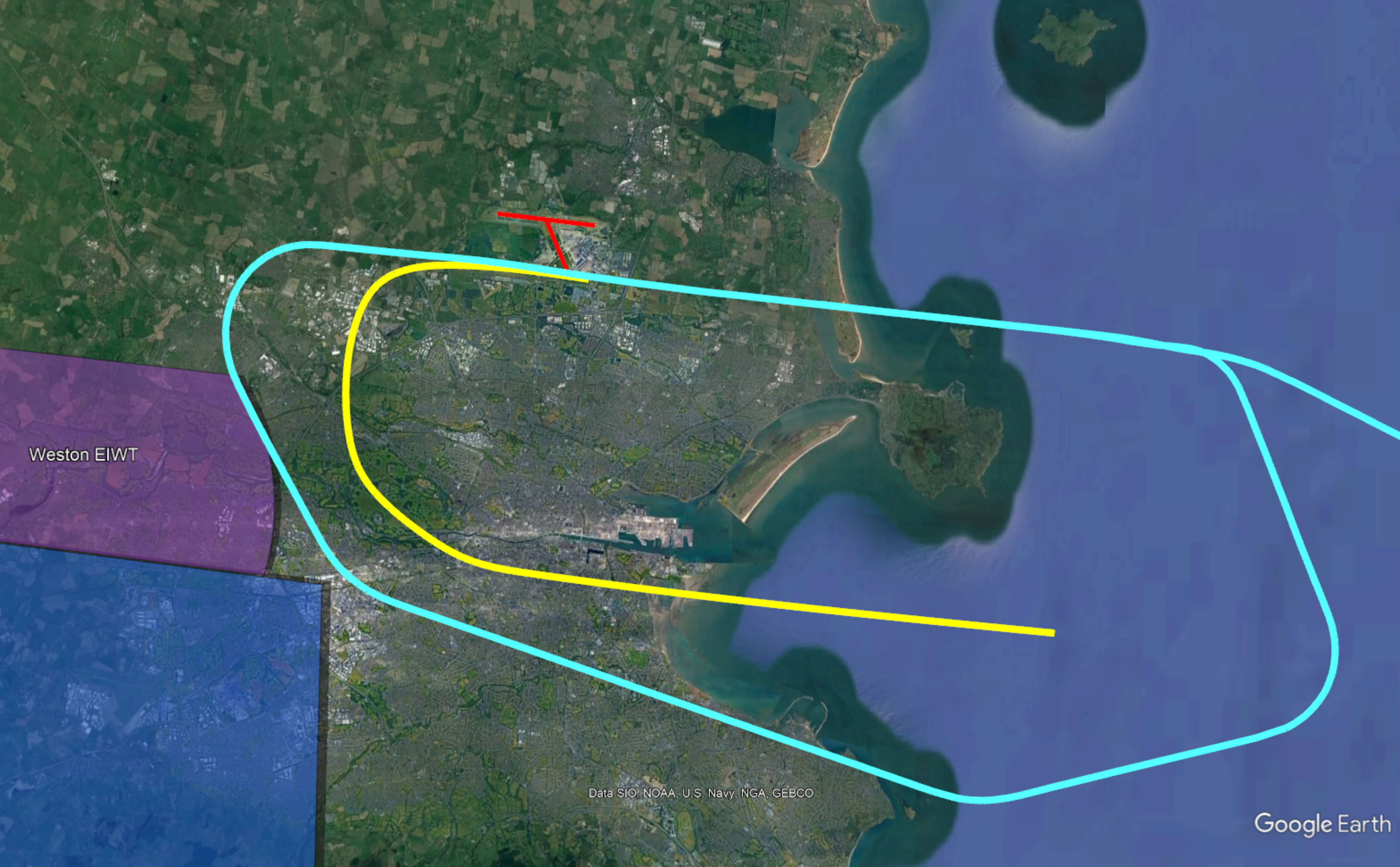
    Ryanair flight FR119 performed a missed approach. Because the existing published missed approach route is dangerous, Air Traffic Control staff must intervene and redirect the aircraft every time one happens. In this case they sent the Ryanair jet on almost the exact missed approach path that AirNav has told Minister Jack Chambers cannot be done because it would interfere with the massive block of airspace reserved for the Aircorp.


    Missed Approach Comparison. Proposed vs actually flown by Ryanair

    So let’s have a look at the “not workable” proposal which we explain in a separate article. Here our proposed missed approach track is in yellow shown against the flight path actually flown by Ryanair under instruction from the Tower controllers at Dublin Airport.

    The data shows that at the point where the two tracks diverge the aircraft was already at 2800 ft, leveling and accelerating, already well above the 2000ft ceiling of Weston airspace. They continued to gently climb to 4000 ft and managed to avoid both laterally and vertically infringing the blue block which it Aircorp reserved airspace around Baldonnell.

    So then, far from not workable, they actually did it. They flew over Dublin city, D6 and D4 and no one lost their mind about the noise, a concern raised by AirNav about the 1/day missed approach, but not about 300+ departures over large towns in Meath.

    Once again it is apparent that the proposal is perfectly workable. AirNav and Dublin airport could do this in a matter of months … IF THEY WANTED TO!